
LSAW STEEL PIPE Manufacturer
TUSPIPE produces LSAW steel pipes (Longitudinally Submerged Arc Welded steel pipes) in strict compliance with standards such as ASTM A252, utilizing JCOE/UOE forming processes. With precise control over raw material selection and every stage of production, we provide high-quality LSAW steel pipes.
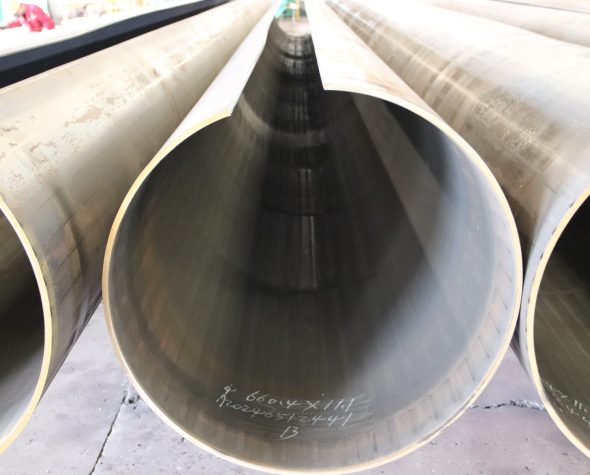
LSAW TUBO
LSAW (Longitudinal Surface Submerged Arc Welded) pipe is constructed from a single medium-thick sheet of steel, formed using the JCOE/UOE process, and then welded using double-sided submerged arc welding. This weld seam is characterized by high quality and dimensional accuracy. LSAW steel pipe offers significant advantages in high-pressure, long-distance transportation applications such as offshore engineering, especially after anti-corrosion treatment, which extends its service life.
- High quality welds: Submerged arc welding provides uniform and high quality welds.
- Variety of sizes: large diameter and thick walled steel pipes can be manufactured.
- Wide range of applications: Commonly used in oil and gas pipelines and offshore platform construction.
LSAW PIPE SPECIFICATION
Below are the specific parameters of the LSAW pipes produced by our company – TUSPIPE. As you can see, TUSPIPE is a steel pipe factory with 25 years of experience. We are located in China and support import and export trade. We have many countries in the world for cooperation. If you have any pipe needs, you can contact us by email.
| Tamaños | Outer Diameter: Φ406.4mm~Φ1422.4mm (common large-diameter line pipe) |
| Length: 5.8m~12.5m (standard single length) | |
| Gama de espesores de pared | Conventional: 6mm~50mm (deep-sea pipelines can reach over 40mm) |
| Special Requirements: 1.5mm~60mm (customized based on project requirements) | |
| Presión nominal | Applicable Standards: API 5L PSL1/PSL2, ISO 3183-3 |
| Steel Grades: L245~X80 (yield strength 245MPa~555MPa) | |
| Material | Carbon Steel and Alloy Steel |
| Processing | UOE/JCOE |
| Pruebas | Water Column Ultrasonic Testing + Industrial X-ray Television Inspection |
| Rendimiento | Resistant to hydrogen-induced cracking and sulfide stress corrosion, high-temperature resistance, and adaptable to deep-sea environments. |
LSAW pipe outside diameter (OD)
- Small diameter pipe: 406mm-508mm
- Medium diameter pipe: 610mm-914mm
- Large diameter pipe: 1020mm-1626mm
LSAW pipe wall thickness (WT)
- Thin wall pipe: 6mm-12mm
- Medium wall thickness pipe: 12mm-18mm
- Thick wall pipe: 18mm-25mm
| Small diameter steel pipe | Medium diameter steel pipe | Large diameter steel pipe | ||||||
| O.D.(mm) | W.T. (mm) | Proceso | O.D.(mm) | W.T. (mm) | Aplicaciones | O.D.(mm) | W.T. (mm) | Proceso |
| 406.4 | 6.0-40.0 | UOE/JCOE | 800 | 12.0-50.0 | Chemical pipelines/structural support | 1422.4 | 20.0-60.0 | JCOE only (UOE maximum 1620mm) |
| 508 | 8.0-50.0 | JCOE | 1016 | 18.4-33.0 | High-pressure oil and gas trunk lines (X80) | 1524 | 25.0-60.0 | Non-standard customization available |
| 610 | 10.0-60.0 | JCOE | 1219 | 18.4-50.0 | Deep-sea/polar projects | |||
LSAW steel pipe PROCESS
There are two main processes for LSAW pipe production: UOE and JCOE. Both processes utilize pre-welding, submerged arc welding, and expansion, but they differ in their weld preparation and application scenarios. Below is a breakdown of the production processes, along with their advantages and disadvantages.
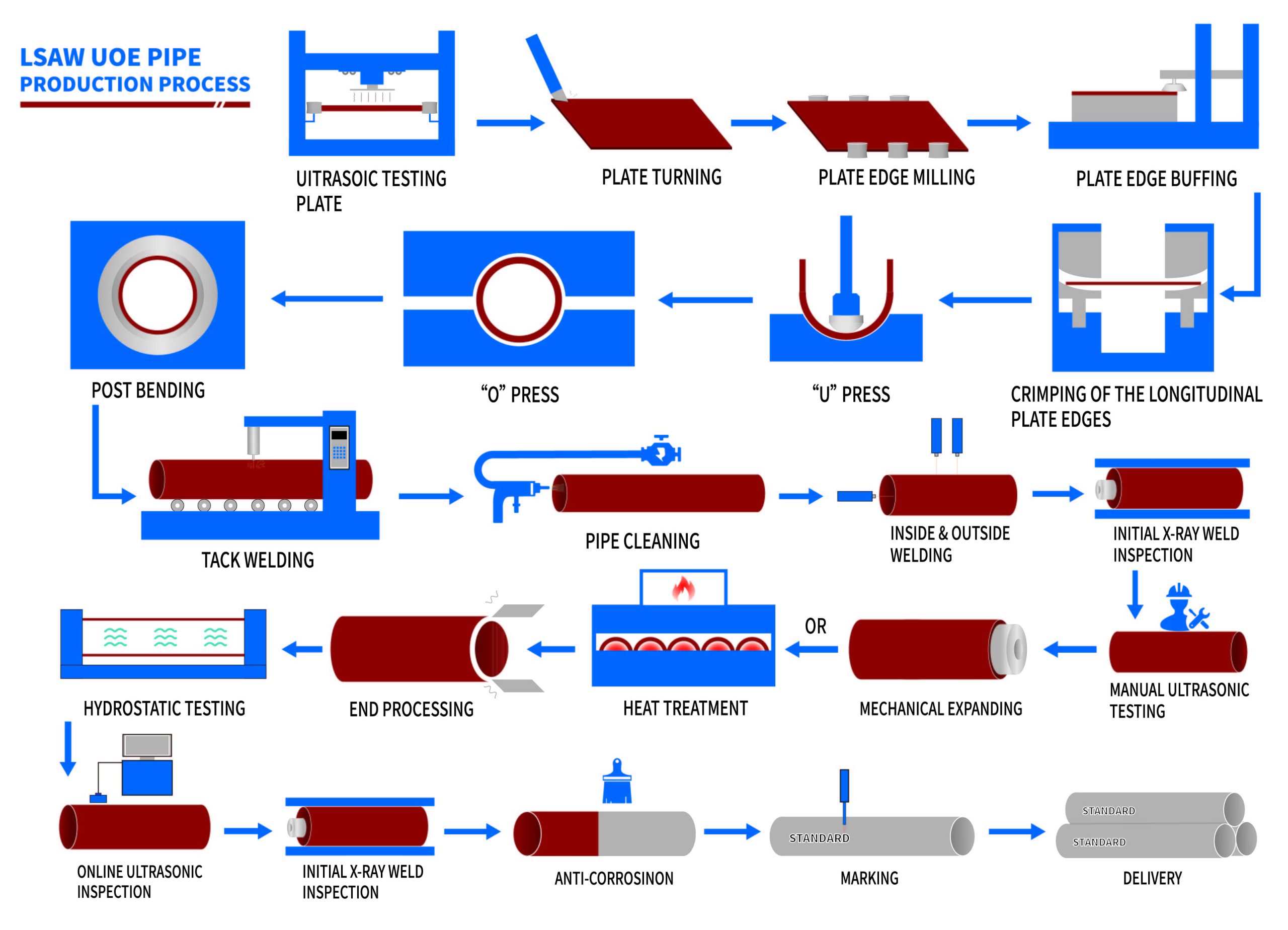
JCOE Process
- 1. Steel Plate Pretreatment: Flattening, cutting, beveling, leveling, and bending.
- 2. UO Bending: Pressing the steel plate into a“ U” in one step; then mechanically closing it into a round tube-“O”.
- 3. Welding: Advanced gas shielded welding, also known as pre-welding; then internal and external submerged arc welding.
- 4. Expansion: Mechanical expansion to eliminate ovality and improve dimensional accuracy.
- 5. Post-Processing: Heat treatment, nondestructive testing, and hydrostatic testing.
UOE Features: High single-tube production efficiency, suitable for large-diameter, thick-walled pipes. A disadvantage is that the weld strength is not as good as with the JCOE process.
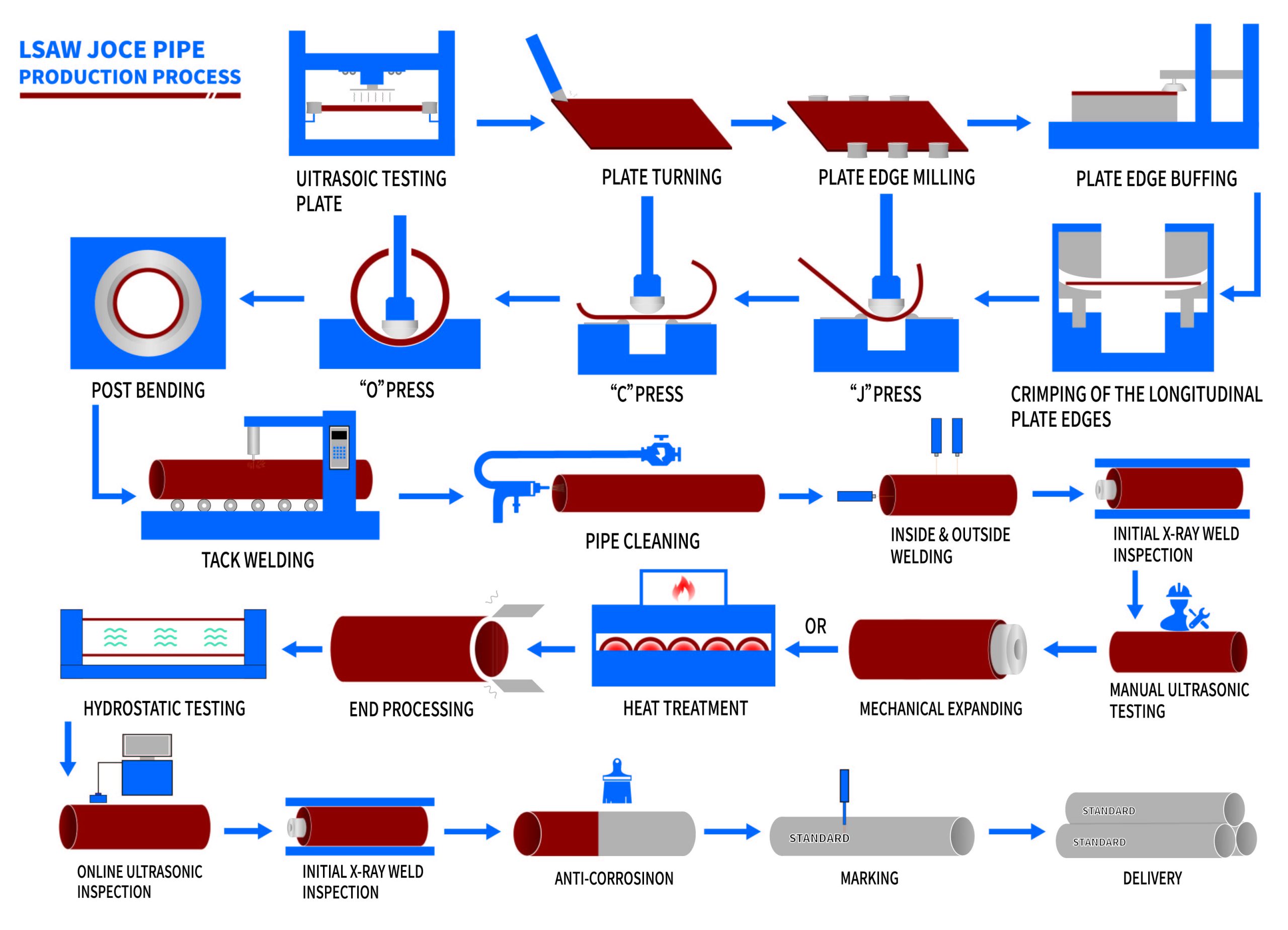
UOE Process
- 1. Steel Plate Pretreatment – Flattening, cutting, and edge preparation of the steel plate.
- 2. JCOE Bending – A hydraulic press press presses the steel plate into a “J”, then bends it to a“ C”, and finally to an “O”.
- 3. Welding: Advanced gas shielded welding (also known as pre-welding) is performed, followed by internal and external submerged arc welding.
- 4. Expansion: Mechanical expansion is performed to eliminate ovality and improve dimensional accuracy.
- 5. Post-Processing: Heat treatment, nondestructive testing, and hydrostatic testing.
JCOE Process Characteristics: Suitable for pipes with thicker walls, but with lower production efficiency.
LSAW STEEL PIPE PRODUCTION
In the manufacturing process of steel pipe, LSAW and UOE/JCOE processes are three very important pipeline production processes.
Among them, LSAW steel pipes usually use high-strength low-alloy high-strength steel. The selection, thickness and composition of these steel plates have a direct impact on the properties and quality of the pipes.
Common steel plate specifications range de 5mm to 50mm thickness, width range from 500mm to 2500mm.
You can click on the link below to view the blog in detail.
Proceso de producción y ventajas de los tubos de acero JCOE
UOE Steel Pipe Production Process And Advantages
LSAW PIPE STANDARDS
LSAW pipes are manufactured and used in accordance with several international and regional standards. It not only ensures the high quality and high performance of LSAW pipe. It also has a very important role in promoting the global pipeline industry.
- ASTM A252: A standard published by the American Society for Materials and Testing for welded steel pipes. It is suitable for welding steel pipe for bridge and structure.
- GB/T 8163: For welded steel pipes for fluid transport, this standard makes detailed specification requirements for the manufacturing process and use of steel pipes.
- EN 10208 is a European standard with a focus on the European market. The standard applies to oil and gas pipelines.
PREGUNTAS FRECUENTES
1. What Is the Difference between HSAW and LSAW Pipe?
The main differences between HSAW and LSAW pipes lie in their manufacturing processes and the direction of their weld seams.
LSAW pipes feature straight longitudinal weld seams.
HSAW pipes, on the other hand, are welded in a spiral direction.
2. What Is Longitudinally Submerged Arc Welding (LSAW)?
Longitudinally Submerged Arc Welding (LSAW) is a welding process that uses submerged arc welding to join steel pipes. This process offers high strength and is suitable for large-diameter and high-pressure applications, such as the transportation of oil and natural gas.
3. What Does SWR Stand for in Plumbing?
SWR stands for Soil, Waste, and Rainwater. This is a core drainage system in building plumbing engineering. The system includes sewage subsystems, wastewater subsystems, and rainwater subsystems. It plays a significant role in wastewater treatment in daily life.
What is The Difference Between ERW and DSAW
ERW (electric resistance welded) and DSAW (double-sided submerged arc welding) are two very common steel pipe manufacturing processes.
ERW (electric resistance welded) relies on the heat generated by an electric current to melt the joints of the steel plate. Moderate strength, low cost.
DSAW (Double-sided submerged arc welding) uses welding wire and flux on both sides of the pipeline, arc heating to achieve welding, welding quality is high.